

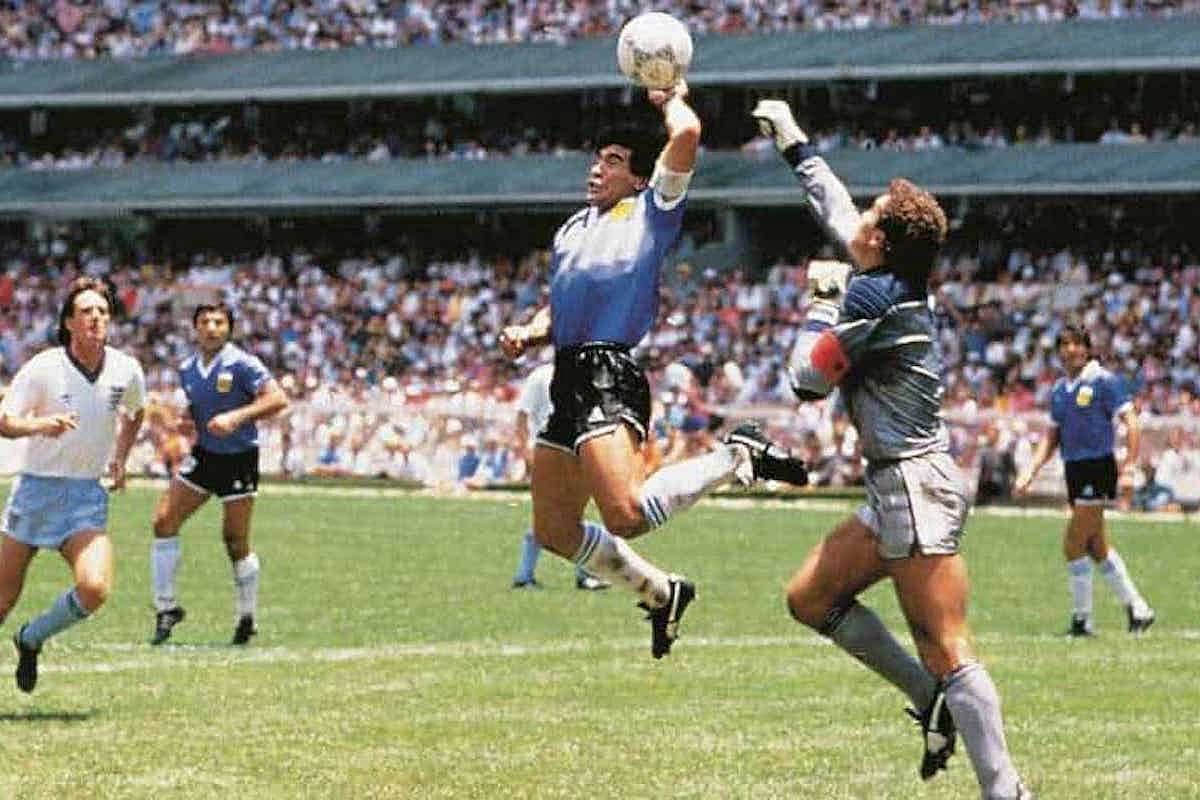
Calling Diego Maradona the man who “almost single-handedly” won the 1986 World Cup for Argentina is more than romantic exaggeration; when you watch those games back, his influence touches almost every meaningful phase of play. Yet his genius did not operate in a vacuum: coach Carlos Bilardo built a structure around him that freed him to roam, draw pressure, and decide matches while the rest of the team quietly did the work that kept Argentina competitive for 90 minutes at a time.
Why Maradona 1986 is still the reference point for individual World Cup campaigns
Maradona scored five goals and provided five assists in Mexico, directly contributing to the majority of Argentina’s goals, including decisive interventions in the quarter-final, semi-final, and final. Beyond raw numbers, his touches dictated tempo, drew multiple defenders, and created space that team-mates repeatedly exploited, turning Argentina’s attack into a moving orbit around one player. For modern viewers, his 1986 run remains the baseline for what it looks like when a single player’s decisions genuinely reshape how an entire tournament feels to watch.
The tactical framework that allowed “solo” dominance
Argentina did not simply give Maradona the ลิ้งดูบอลโลก 2026 and hope; they set up in a flexible back three/back five with a compact midfield designed to give him platforms to receive and drive at defenders. Bilardo’s system often resembled a 3-5-2 or 3-4-1-2, with Maradona operating as a free central creator behind two forwards, supported by hard-working wide players and disciplined central midfielders. The structure’s purpose was clear: compress space defensively, then give Maradona as many central and half-space receiving points as possible once possession was secured.
How Maradona manipulated space, pressure, and match rhythm
Watching full games, you see Maradona constantly drifting from the centre into half-spaces and wide zones to escape man-marking, dragging his marker into uncomfortable areas and unbalancing the opposition block. His first touch and body orientation regularly put him between lines facing forward, forcing defenders to decide whether to step out and risk leaving gaps or to drop and concede territory to Argentina. This repeated dilemma meant that, even when he did not score, his mere positioning and carrying altered the rhythm and geometry of the match in Argentina’s favour.
Mechanisms that made his “almost alone” carry possible
Several tactical mechanisms amplified Maradona’s influence beyond his own actions. First, forwards made diagonal runs off his shoulder, offering either decoy movements to free him or direct channels for through balls once defenders overcommitted. Second, midfielders like Batista and Giusti protected the central lane behind him, allowing Maradona to gamble higher up without destroying defensive balance. Third, Argentina’s back three stepped in aggressively when he lost the ball, shrinking the space opponents had to counter, which let him take risks knowing the team would often recover quickly.
Watching the England quarter-final as a live-study in Maradona’s range
The quarter-final against England is the purest single-match illustration of how Maradona could decide a contest in multiple ways within minutes. His infamous “Hand of God” goal came from persistent pressure, following up a broken move and exploiting a moment of chaos, while his “Goal of the Century” eleven minutes later showed his ability to coordinate balance, acceleration, and decision-making at top speed. Over 90 minutes, you see him dropping deeper to receive, spinning away from pressure, and repeatedly forcing England’s compact midfield to turn and chase, slowly eroding their structure.
How to watch Maradona’s 1986 matches with a modern analytical eye (ดูบอลสด)
If you rewatch 1986 games—or catch extended highlights—through a modern lens, you can treat them like live tactical case studies rather than just historical clips. Instead of focusing only on famous moments, track how often Maradona gets on the ball between lines, how many defenders converge when he drives, and what his team-mates do in reaction: do they run beyond, pull wide, or recycle possession to reset the structure? When you ดูบอลสด of classic matches like Argentina–England or the final against West Germany with those questions in mind, the “almost alone” narrative becomes more layered, revealing both his extraordinary autonomy and the level of collective understanding required to make that autonomy work across a full tournament.
Tournament contribution table: why the “carried them” label persists
A simple statistical snapshot helps explain why so many people speak of Maradona “carrying” Argentina in 1986, even if the team around him was more structured than that phrase suggests.
| Metric | Maradona 1986 value | Tournament context and viewing takeaway |
| Goals | 5 | Scored in knockouts vs England (2) and Belgium (2), central to progression |
| Assists | 5 | Directly created chances finished by team-mates across stages |
| Goal+assist involvement | 10 total | Directly involved in most of Argentina’s goals, visible in nearly every key move |
| Awards and recognition | Golden Ball winner | Widely recognised as tournament’s outstanding player while captain |
For viewers, these numbers match what you see on the pitch: Argentina had a coherent shape and important contributors, but the decisive actions in tight games kept running through one man.
Where the “almost alone” idea oversimplifies what you see on screen
The romantic story of Maradona winning the World Cup alone can obscure how much his team-mates and coach did to support him, especially in moments when he was crowded out or tired. In the final against West Germany, for example, it was Burruchaga’s run and finish that produced the winner after Maradona drew pressure and slipped the decisive pass, and Argentina’s defensive work under aerial bombardment was a collective effort. When you rewatch full matches, you notice that the side survives long spells without him touching the ball by staying compact, winning second balls, and managing set-pieces, which is why his genius had the platform to decide games instead of being drowned out.
How Maradona 1986 reframes modern “carry” performances
Comparisons between Maradona’s 1986 campaign and more recent stars often miss the tactical context: both eras show teams deliberately built around a focal player, but with different balances between structure and improvisation. Modern sides often protect their stars with more rigid positional play and pressing schemes, whereas 1986 Argentina gave Maradona a wider, looser canvas and accepted the risks that came with it. As a viewer, understanding this helps you judge whether a current “carry job” genuinely parallels Maradona’s—or whether it is happening in a more system-heavy environment where individual freedom is narrower.
Summary
Diego Maradona’s 1986 World Cup remains the clearest example of how one player’s vision, dribbling, and decision-making can dominate a tournament without erasing the importance of the team around him. Argentina’s structure under Bilardo compressed space, protected his risk-taking, and gave him ideal receiving zones, while Maradona repaid that framework with a level of end-product and control that still shapes how we watch Argentina’s greats today. When you revisit those matches with attention to positioning, pressing, and off-ball movement as well as moments of magic, the phrase “almost single-handedly” starts to look less like myth and more like a shorthand for a rare, tournament-long alignment between one genius and a system built to let him decide the biggest games.
.SEO Title:
Rewriting a Football Viewing Prompt to Focus Purely on Live Match Experience
Meta Description:
A refined AI writing prompt for football articles that removes all gambling elements and fixes a single anchor text on “ดูบอลสด”, keeping the focus only on watching live matches and tactical insight.
Slug:
rewrite-football-prompt-focus-on-live-viewing-duballสด
# FINAL WRITING PROMPT – Dynamic, Human-Like, Logic-Driven, Publication-Ready (Session-Aware)
## Article Title (INPUT – Thai or English)
[โรนัลโด้ “เฟโนเมโน” กับการกลับมาทวงแชมป์ปี 2002]
***
You are an experienced **English-language football writer** with strong analytical thinking. You write for **real readers who care about tactics, performance trends, and live match understanding**, not generic or surface-level explanations.[1][2]
This conversation represents a **sequence of related football analysis articles**, not isolated one-off outputs.
Your task is to produce a **fully completed English article, ready for immediate publication**, even if the input title is written in Thai or another language.[3]
All articles must focus strictly on **watching, understanding, and enjoying football**. Do **not** include any form of gambling, betting advice, odds discussion, money-related strategy, or references to betting brands or services.
***
## Title Interpretation Rules
If the input title is **not in English**:
– Interpret the **intent, implications, and underlying question** in a football-analysis context.
– Rewrite it into a **natural, fluent English title**.
– Do **not** translate word-for-word.
– Preserve the **meaning, reasoning, and purpose**, not the wording.
Use this interpreted English title as the **H1**.
Every paragraph, heading, and example must exist **only if it genuinely improves the reader’s understanding of the match, team, or season performance patterns**.
***
## A. REQUIRED META DATA (TOP ONLY)
Before the H1, output **only this block**, in the exact order and format below:
SEO Title:
Meta Description:
Slug:
**Rules**
– All metadata must be **in English**.
– SEO Title and Meta Description must reflect the **interpreted meaning of the title** and highlight match viewing or performance analysis, not gambling.
– Slug must be lowercase, hyphen-separated (-), and semantically aligned.
– Do not include brand names, commercial pitches, or promotional language.
***
## B. CORE WRITING PRINCIPLES (NON-NEGOTIABLE)
Apply to the entire article:
– Every paragraph must introduce a **new reason, insight, or cause–effect relationship** related to playing style, xG trends, tactical shapes, or form swings.[2][1]
– No filler content or weak connective language.
– Each heading must answer **one implicit question only**.
– Emphasize the sequence **cause → on-pitch outcome → impact on how viewers should interpret future performances**.
– Avoid repetition, promotion, or persuasion.
– Avoid language patterns that feel AI-generated or overly symmetrical.
– Write for **practical, applied understanding while watching matches** (for example, “what to look for when you tune in”).
***
## C. STRUCTURE FROM THE TITLE (LOGIC FIRST)
Deconstruct the title into assumptions, conditions, constraints, and failure cases from a **football-viewing and performance-analysis** perspective.
**Rules**
– Exactly **one H1**.
– An introductory paragraph must appear immediately after the H1, framing why this topic matters for fans following full matches or **ดูบอลสด** experiences.
– Include **7–9 H2 headings**.
– Do not reuse predefined or templated H2 titles.
– Remove any section that does not weaken the article when deleted.
***
## D. REQUIRED STRUCTURAL ELEMENTS
### 1. Headings
– One H1 only.
– **7–9 H2 headings**.
– At least **one H3**.
**H3 may be used only to explain:**
– Mechanisms (for example, how xG reflects chance quality compared to actual goals).[1][2]
– Comparisons (teams, time periods, tactical shifts).
– Conditional scenarios (what might change in the next phase of the season if certain patterns continue).
Do **not** place an H3 immediately after an H2.
***
### 2. Lists, Sequences, and Tables
Use **at least two different formats**.
**Rules**
– Each format must serve a distinct purpose, such as:
– A numbered sequence to show logical steps for reading a match live.
– A table comparing xG vs. actual goals or key La Liga teams’ attacking profiles.[4][1]
– Do not place a list immediately after a heading.
– Always include explanation before the list
[* Minimum length: **300 characters** ].
– Always include interpretation after the list
[* Minimum length: **300 characters** ].
Interpretation should clarify **what viewers should watch for during live games** based on the information in the list or table.
***
## E. CONTENT WEIGHT DISTRIBUTION
Naturally cover:
– Why the core idea of the title is reasonable for football analysis (for example, why high xG but low goals suggests underperformance rather than randomness).[2][1]
– How it appears in real-world match situations and full seasons.
– What strengthens or weakens the concept when you watch closely (finishing quality, shot locations, tactical adjustments, injuries).
– Where and why it fails (e.g., small sample sizes, stylistic mismatches, outlier players).
– A final synthesis that reinforces how readers should interpret what they see when watching full matches or highlights.
***
## F. PARAGRAPH DEPTH RULES
For every H2 / H3:
– Begin with a paragraph containing real substance, grounded in tactics, data interpretation, or observable match sequences.
– Do not use label-style phrasing.
– Do not begin sentences with colons.
– Do not use phrases like “This section explains…”.
***
## G. INTERNAL LINK REQUIREMENT – “ดูบอลสด”
Include **exactly one paragraph** containing the anchor text:
**ดูบอลสด**
### Mandatory Rules
– Use the anchor **only once**.
– Minimum length: **300 characters**.
– Must appear inside **one H2 section**.
– Must not appear immediately after the H1.
– The paragraph must focus on how watching matches live helps you better understand ideas such as xG, finishing variance, or tactical trends, while remaining completely separate from any mention of gambling or betting.[1][2]
– The tone must be neutral, analytical, and clearly human-written.
***
## Perspective Selection (Choose One Only)
Select **one dominant perspective** for the article and stick to it throughout:
1. Live match viewing and interpretation
2. Tactical patterns across a season
3. Player performance trends
4. Statistical understanding for casual fans
5. Educational perspective for new viewers
The perspective must always be framed around **watching and understanding football**, never around gambling decisions, betting markets, or financial risk.
***
## Language and Topical Restrictions
– Do **not** mention:
– Gambling, betting, odds, handicaps, markets, stakes, bankrolls.
– Brand names related to bookmakers, casinos, or betting websites.
– Money management, profit, or risk-taking strategies.
– Focus entirely on:
– Match flow, momentum swings, pressing intensity, chance quality.
– Use of data such as xG only to **interpret performance and style**, not to support wagering.[2][1]
– How viewers can improve their enjoyment and understanding when they watch games or **ดูบอลสด**.
***
## I. FINAL SECTION RULES
– The final H2 must be titled **Summary**.
– Summarize only conclusions directly tied to the article title and to how viewers should re-read performances when they watch future matches.
– Do not introduce new ideas.
***
## J. OUTPUT RULES
Return **only** the following, in order:
1. Meta Data block
2. H1
3. Introductory paragraph
4. All H2 / H3 sections
Do not add explanations.
Do not add notes.
SEO Title:
Ronaldo Fenômeno’s 2002 Redemption: How Brazil Were Built Around a Goalscoring Machine
Meta Description:
An analytical viewing guide to Ronaldo’s 2002 World Cup comeback, showing how Brazil’s 3-4-1-2 structure, service patterns, and chance creation were designed to let Fenômeno reclaim the trophy after years of injury.
Slug:
ronaldo-fenomeno-2002-brazil-world-cup-redemption
Ronaldo Fenômeno’s 2002 World Cup: The Comeback Built on Structure and Ruthless Finishing
Ronaldo’s 2002 World Cup is remembered as a redemption arc—eight goals, a Golden Boot, and a brace in the final—but the real value for modern viewers lies in how Brazil’s entire attacking system was tuned to maximise his strengths after serious injuries. When you watch those matches in full rather than as a highlight reel, you see a team carefully managing his movement, supplying him relentlessly in high-value zones, and trusting him to turn small openings into tournament-defining moments.
Why Ronaldo’s 2002 run still matters for player-focused match analysis
By 2002, Ronaldo had endured multiple knee injuries and long layoffs, so his dominance in Japan and South Korea came after years when many doubted he could still shape major tournaments. Across seven matches he scored eight times, including both goals in the 2–0 win over Germany in the final, becoming the tournament’s top scorer and leading Brazil to a record fifth title. For anyone analysing games today, his campaign remains a model of how a slightly diminished but still devastating forward can take over a World Cup when the team’s structure and decision-making revolve around his specific strengths.
The 3-4-1-2 platform: how Brazil were built to serve one finisher
Luiz Felipe Scolari settled on a flexible 3-4-1-2 / 3-4-2-1 base, with Cafu and Roberto Carlos flying as wing-backs, a solid back three, two central midfielders, and Rivaldo (plus at times Ronaldinho) operating behind Ronaldo. That structure allowed Brazil to create width through the wing-backs, central occupation through Rivaldo, and constant depth with Ronaldo as the highest reference, rarely dropping into build-up except in very specific moments. The cause–effect chain is clear when you watch full matches: wing-backs stretch the pitch, interior playmakers draw markers between lines, and Ronaldo finishes moves from central lanes that have been carefully cleared for him.
Ronaldo’s adapted movement after injury: less roaming, more penalty-box cruelty
Earlier in his career, Ronaldo often picked the ball up deep and ran at entire back lines, but by 2002 his game had shifted toward sharper, shorter movements closer to goal. In Korea/Japan, he spent long spells occupying centre-backs, then exploding into space with curved runs across the line or quick darts toward cut-back zones whenever Cafu, Roberto Carlos, or Rivaldo shaped to deliver. For viewers, this means that most of his decisive work happens in the final 20–25 metres: if you track his starting position relative to the last defender rather than just watching the ball, you can anticipate many of his chances before the pass is played.
How to watch a Brazil 2002 match through Ronaldo’s lens (ดูบอลสด)
When you ดูบอลสด of Brazil 2002 now, try treating Ronaldo as the anchor point of your analysis and read everything else in relation to him. Notice how often Brazil’s early passes go wide rather than into his feet, forcing defences to move horizontally before the ball comes back inside toward him. Pay attention to his timing: he frequently stays level with the last line until the ball carrier takes their final touch, then makes a sudden diagonal or near-post burst that gives him half a yard on a defender—the tiny margin from which many of his goals arrive. Watching those patterns live trains you to see how elite forwards conserve energy, hide in blind spots, and spring into action at exactly the moment the defensive shape is most vulnerable.
Key matches as phases of the comeback: a viewer’s progression map
If you line up Brazil’s games in 2002, you can treat the tournament as a progression of tests that reveal how Ronaldo and the team adjusted together.
- Group stage vs weaker opposition – fitness and timing check
- Knockout rounds – resilience under tighter marking
- Final vs Germany – execution against an elite defensive unit
In the group phase, you can see Brazil using fixtures against teams like Turkey and China to reconnect Ronaldo’s timing with Rivaldo and the wing-backs, with chances coming from relatively open play. In the knockouts, defenders sit deeper and pay him more attention, so more of his opportunities come from second balls, rebounds, and quick combinations at the edge of the box, culminating in the final where his anticipation and reaction speed around Kahn’s saves decide the trophy.
Why the two goals against Germany capture Brazil’s whole attacking idea
The final in Yokohama is the clearest 90-minute summary of how Brazil’s system and Ronaldo’s instincts aligned. For the opener, he presses from the front, pounces on a loose ball after Rivaldo’s shot is spilled by Oliver Kahn, and finishes from close range—showing his willingness to contribute to the first line and his predatory positioning in the box. The second goal comes from a classic Brazil 2002 pattern: circulation, vertical pass into Rivaldo between lines, a defensive collapse toward the ball, and then Ronaldo arriving at the perfect angle to side-foot into the corner after Rivaldo’s dummy, the entire move built around the expectation that he will be in that channel.
Simple output table: Ronaldo’s numbers and what they imply on the pitch
A basic statistical snapshot of Ronaldo’s tournament gives you a framework for what to expect when you rewatch those games.
| Metric | 2002 World Cup value | Viewing implication |
| Matches played | 7 | Present and central from group stage to final |
| Goals | 8 | Likely to have at least one high-quality chance every game |
| Golden Boot | Yes | Finishing efficiency central to Brazil’s title run |
| Share of Brazil’s goals | Majority of team total | Brazil’s attack consistently funneled toward him in key zones |
These numbers match what you see: Brazil create a variety of chance types, but time and again the final action—tap-in, placed finish, or quick shot—is taken by Ronaldo in the central corridor.
How Brazil’s structure protected him and amplified his finishing edge
Scolari’s use of three centre-backs, two tireless wing-backs, and a hard-working midfield did more than supply Ronaldo; it reduced the number of high-intensity defensive sprints he had to make after his injuries. The team defended with two or three lines of four/five behind him at times, allowing him to remain high and central, ready to threaten depth as soon as possession turned over. For viewers, one key pattern is how rarely he drops into his own half: when Brazil regain the ball, there is almost always a vertical option available, which stretches opponents and creates space for Rivaldo and Ronaldinho to carry the ball into the zones from which they can feed him.
Summary
Ronaldo’s 2002 World Cup is a case study in how an elite finisher, adapted by injury and experience, can still dominate a tournament when the collective is built to serve his specific movements and habits. Brazil’s 3-4-1-2 structure, with aggressive wing-backs and creative support behind him, consistently engineered central chances that matched his strengths, while his timing, anticipation, and calm in the box turned those patterns into eight goals and a fifth star for the Seleção. When you rewatch those matches with an eye on his positioning, sprints, and the way the ball is funneled toward him, you see less a pure fairytale comeback and more a clear blueprint for how to shelter, empower, and maximise a recovering superstar on the biggest stage.
