

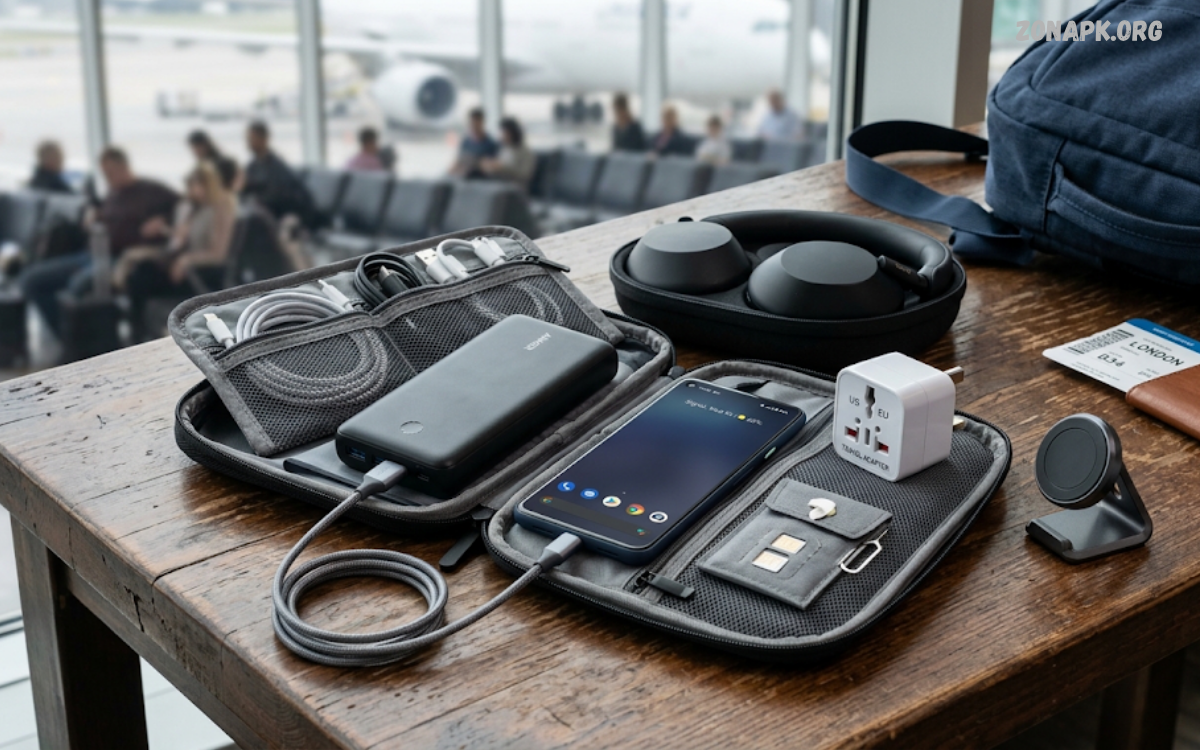
Travel gets easier when you pack the right phone accessories before you leave. A smartphone can handle navigation, communication, photography, entertainment, payments, bookings, and emergencies, but useful accessories can improve battery life, protection, comfort, and convenience on the go.
Choosing the right phone accessories for travel depends on your destination, trip length, transportation method, and how you use your phone. A practical travel kit should remain compact while providing enough power, protection, connectivity, and flexibility for different situations.
Why Phone Accessories Matter During Travel
A smartphone often becomes one of the most important devices during a trip. Travelers use phones to check maps, confirm hotel reservations, translate languages, take photos, communicate with family, access digital tickets, and find local information.
The right accessories can make these activities more convenient. A power bank can provide extra battery capacity, while a durable phone case protects the device from accidental drops. A charging cable, wall charger, and travel adapter can also help keep the phone ready throughout the journey.
Essential Phone Accessories for Travel
A reliable travel accessory kit should focus on practical items, not unnecessary gadgets. The most useful products usually include a power bank, fast charger, charging cable, travel adapter, protective case, screen protector, car mount, wireless earbuds, and cable organizer.
Travelers should choose accessories that match their smartphone model and destination. Compact designs are especially useful because luggage space can become limited quickly. Lightweight accessories can provide valuable functionality without adding unnecessary weight to a backpack or suitcase.
Power Bank for Travel
A power bank is one of the most useful phone accessories for travel because smartphones can drain quickly when you use GPS, mobile data, cameras, and streaming services. Long flights, road trips, airport delays, and outdoor activities can make it hard to access a power outlet.
When selecting a power bank, consider battery capacity, charging speed, size, weight, and device compatibility. A compact model works well for everyday travel, while a higher-capacity option may suit longer journeys with limited charging opportunities.
Fast Charger for Travel
A fast charger can reduce the time a traveler needs to stay near a power outlet. Modern smartphones can support faster charging technologies, allowing users to restore significant battery power during short breaks at airports, hotels, restaurants, or transportation terminals.
A travel charger should ideally support the smartphone’s charging standard. USB-C Power Delivery is widely supported by many modern devices, but travelers should verify compatibility before purchasing. A compact charger with multiple ports can also reduce the number of charging adapters required.
USB-C Charging Cable
A dependable charging cable is essential because even the best charger becomes useless without a compatible cable. USB-C cables are common across many smartphones, tablets, headphones, power banks, and other modern devices, making them a convenient option for travelers carrying multiple gadgets.
Travelers should consider carrying at least one spare cable. A backup can be helpful if the primary cable becomes damaged, misplaced, or unavailable during a trip. Choosing durable cables with reinforced connectors can also improve reliability during frequent packing and unpacking.
Universal Travel Adapter
International travelers may encounter different electrical outlets depending on the country they visit. A universal travel adapter can allow compatible chargers to connect to various outlet types without requiring travelers to purchase separate plug adapters for every destination.
Before using an adapter, check the voltage requirements of the destination and the electrical devices being connected. A plug adapter changes the physical connection but does not necessarily convert voltage. Travelers should use suitable equipment when voltage conversion is required.
Protective Phone Case
A protective case can reduce the risk of damage caused by drops, scratches, and everyday travel accidents. Phones can be exposed to crowded airports, busy streets, hotel rooms, vehicles, outdoor activities, and luggage compartments during a trip.
A travel-friendly case should provide adequate protection without becoming excessively bulky. Raised edges around the screen and camera can provide additional protection, while a textured or grippy surface can make the phone easier to hold when taking photos or navigating unfamiliar locations.
Screen Protector
A screen protector adds another layer of protection against scratches and minor impacts. Since travelers frequently place phones in pockets, bags, luggage compartments, and shared spaces, the screen can encounter dust, keys, coins, and other objects.
Tempered glass protectors are popular because they can provide a hard protective surface while maintaining touchscreen functionality. Travelers should choose a protector designed specifically for their phone model to ensure proper alignment around the display and front camera.
Phone Wallet or Card Holder
A phone wallet can combine smartphone protection with storage for essential cards. This can reduce the number of separate items a traveler needs to carry, especially during short trips, sightseeing, or quick visits to nearby locations.
However, travelers should avoid keeping every important card or document in one place. Separating backup payment methods can provide additional security if a phone or wallet becomes lost. A phone wallet works best as a convenient option rather than the only storage location for important items.
Wireless Earbuds
Wireless earbuds can make long journeys more comfortable by providing music, podcasts, audiobooks, navigation instructions, and entertainment without requiring a wired connection. They are particularly useful during flights, train journeys, road trips, and waiting periods.
Battery life and charging convenience should be considered when choosing travel earbuds. A charging case provides additional battery capacity, while noise-reduction features can help travelers enjoy audio in busy environments. Travelers should keep volume at a safe level, particularly in public areas.
Noise-Canceling Headphones
Noise-canceling headphones can be useful for travelers who spend long periods in airplanes, trains, buses, or busy terminals. Active noise cancellation can reduce certain types of background sound and make listening more comfortable.
Headphones are generally larger than earbuds, so travelers should consider luggage space and comfort. Foldable designs can make transportation easier. Long battery life is also useful when travelers may not have frequent access to charging points.
Phone Stand
A compact phone stand can be surprisingly useful during travel. It can hold a phone upright while watching videos, following recipes, reading information, making video calls, or using the device as a navigation screen.
A foldable stand takes up little space and can fit inside a small travel pouch. Travelers should choose a stable design that can support the phone securely. Adjustable viewing angles can make the stand more useful across different environments.
Car Phone Mount
A car phone mount can improve convenience during road trips by keeping navigation information visible without requiring the driver to hold the phone. A secure mount can also help passengers use the device for maps, music controls, or travel information.
Drivers should always follow local traffic laws and avoid interacting with a phone while driving. The mount should be positioned where it does not obstruct the driver’s view. Travelers using rental cars should select a mount that is easy to install and remove.
Cable Organizer
Multiple cables can quickly become tangled inside a travel bag. A cable organizer provides separate compartments for charging cables, adapters, earbuds, memory cards, and small electronic accessories.
A compact organizer can save time during security checks and hotel stays because accessories remain together. Travelers can also identify missing items more easily before leaving accommodation. A water-resistant organizer can provide additional protection against accidental spills.
Waterproof Phone Pouch
A waterproof phone pouch can protect a smartphone during activities involving water, rain, beaches, pools, boating, or unexpected weather. It can also reduce exposure to sand and moisture in environments where ordinary phone cases may not provide sufficient protection.
Travelers should check the manufacturer’s waterproof rating and usage instructions before relying on a pouch near water. It is also wise to test the pouch before placing an expensive smartphone inside it, particularly before activities where retrieval could be difficult.
Car Charger
A car charger can be useful when road travel is part of the itinerary. Long drives can quickly reduce smartphone battery levels when navigation, music streaming, mobile data, and calls are being used continuously.
A modern USB-C car charger can support compatible smartphones and other devices. Travelers should choose a reliable charger from a reputable manufacturer and verify that its output matches the requirements of the devices being charged.
MagSafe and Magnetic Accessories
Magnetic smartphone accessories can provide convenient mounting and charging options on compatible devices. Magnetic wallets, stands, mounts, and charging accessories can reduce the need for cables in certain situations.
Compatibility should be checked carefully before purchasing magnetic accessories. Some phones require a compatible case or magnetic attachment system. Travelers should also consider whether magnetic mounting provides enough stability for their intended use, particularly inside vehicles.
Portable Wireless Charger
A portable wireless charger can provide cable-free charging for compatible smartphones. This can be convenient in hotel rooms, airports, lounges, and other locations where travelers want to reduce cable clutter.
Wireless charging can generate heat and may charge more slowly than certain wired charging methods. Travelers should select a charger designed for their specific smartphone and understand its charging requirements before relying on it as their primary power solution.
Travel-Friendly Smartphone Camera Accessories
Modern smartphones can capture high-quality photos and videos, but small camera accessories can improve certain travel photography situations. A compact tripod, phone grip, or lens accessory can provide greater stability and creative flexibility.
Travelers should prioritize lightweight equipment because photography accessories can become inconvenient when carrying luggage for long periods. A small tripod or adjustable phone grip may provide more practical value than carrying multiple specialized accessories.
Selfie Stick and Tripod
A compact selfie stick with tripod functionality can be useful for travelers who want group photographs or hands-free shots. It can also help capture wider scenes when the phone camera alone cannot provide the desired framing.
Travelers should check airline and venue rules before carrying or using larger selfie sticks. A compact model is generally easier to store and transport. A secure phone holder is essential to reduce the risk of the smartphone falling while taking photographs.
Portable Storage Accessories
Travel can generate large amounts of photographs and videos, especially during long holidays. Portable storage can help manage files when smartphone storage becomes limited, depending on the phone’s supported storage options.
Travelers should also maintain backups of important photos and documents. Cloud storage can provide another layer of protection when internet access is available. Keeping important travel documents in more than one secure location can reduce the impact of device loss.
SIM Card and eSIM Support
Connectivity is an important part of modern travel, particularly when travelers depend on maps, translation tools, messaging, ride services, and online bookings. A compatible local SIM or eSIM can provide mobile data without relying entirely on public Wi-Fi.
Travelers should check whether their phone supports eSIM technology and whether the device is carrier-unlocked when required. International roaming policies and local mobile plans can vary significantly, so travelers should review the relevant terms before departure.
Portable Wi-Fi Device
A portable Wi-Fi device can provide internet access for multiple devices when traveling. It can be useful for families, groups, business travelers, or people carrying smartphones, tablets, and laptops.
The usefulness of a portable Wi-Fi device depends on network coverage, data allowances, battery life, and destination availability. Travelers should compare these factors before deciding whether a portable hotspot provides enough value compared with a local SIM or eSIM.
Bluetooth Tracker
A Bluetooth tracker can help travelers locate important belongings such as luggage, backpacks, or accessory pouches. When compatible with a smartphone’s tracking network, a tracker can provide location information or proximity alerts.
Trackers should be used as an additional organizational tool rather than a guarantee against loss or theft. Travelers should still keep passports, payment cards, phones, and other important belongings secure and within reasonable control.
Travel Accessories for Airport Use
Airports often involve long waiting periods, security checks, limited seating, and variable access to charging points. A compact power bank, charging cable, wireless earbuds, phone stand, and cable organizer can make airport time more convenient.
Travelers should check current airline and airport rules regarding power banks and lithium batteries before departure. Requirements can vary by airline and destination, so checking official guidance before packing electronic accessories is important.
Phone Accessories for Road Trips
Road trips create different accessory requirements because smartphones may be used for navigation, communication, entertainment, and vehicle charging. A car mount, car charger, power bank, charging cable, and protective case can form a practical road-trip setup.
A dashboard or windshield mount should be installed without blocking the driver’s view. Passengers can manage music and other functions when appropriate, while drivers should avoid manually operating a smartphone when the vehicle is moving.
Read Also: Must-Have Phone Accessories: For Every Smartphone User
Phone Accessories for Outdoor Travel
Outdoor travel can expose smartphones to dust, rain, sunlight, drops, and temperature changes. A rugged case, waterproof pouch, portable power bank, screen protector, and compact charging cable can provide useful protection and flexibility.
Travelers should also consider environmental conditions when selecting accessories. Water resistance, durability, portability, and battery performance may become more important during hiking, camping, beach trips, and other outdoor activities than during a standard city vacation.
How to Choose Phone Accessories for Travel
The first step is to identify the activities included in the trip. A business traveler may prioritize charging equipment, wireless earbuds, and connectivity, while a road traveler may need a car mount and vehicle charger. Outdoor travelers may place greater emphasis on protection.
The destination should also influence accessory selection. International travel may require a universal adapter, while areas with limited electricity access may make a power bank more important. Choosing accessories according to actual travel conditions helps prevent unnecessary purchases.
Lightweight Accessories Are Better for Travel
Travelers should avoid filling their luggage with accessories that provide little practical value. Compact and multifunctional products can reduce both weight and clutter while still covering essential needs.
For example, a charger with multiple ports can replace several individual chargers, while a phone case with a compatible magnetic system may reduce the need for separate mounting accessories. The goal should be creating a compact kit that supports the most important smartphone activities.
Create a Dedicated Phone Travel Kit
Keeping travel accessories together can make preparation easier. A small electronics pouch can hold charging cables, adapters, power banks, earbuds, memory cards, and other compact accessories in one location.
A dedicated kit also reduces the chance of leaving important accessories behind. Before departure, travelers can check the pouch against a simple checklist. After returning to accommodation, placing every accessory back in the same pouch keeps the travel setup organized.
Protect Your Phone During Travel
Phone protection should be considered before the journey begins. A protective case and screen protector can reduce everyday risks, while a secure storage location can help prevent accidental drops or loss.
Travelers should avoid placing phones loosely in bags alongside keys or other hard objects. When visiting crowded locations, keeping the phone secured can also reduce the risk of accidental loss. Regular backups are useful because physical protection cannot prevent every possible problem.
Keep Charging Accessories Organized
Charging equipment becomes easier to manage when every item has a specific place. A cable organizer can separate USB-C cables, charging adapters, power banks, and smaller accessories.
Travelers should inspect cables before departure and replace damaged ones. Carrying a spare charging cable can be helpful during long journeys. Labeling similar cables can also make it easier to identify the correct cable when multiple electronic devices are packed together.
Check Accessories Before Leaving Home
Testing travel accessories before departure can prevent avoidable problems. Connect the charger to the smartphone, test the power bank, confirm the cable works, and verify that the travel adapter fits the destination’s outlet type.
Battery-powered accessories should be charged before leaving home. Travelers should also confirm that important devices have current software, sufficient storage, and required travel applications. Preparing the phone itself is just as important as packing its accessories.
Common Mistakes When Buying Travel Accessories
One common mistake is purchasing accessories without checking compatibility. A cable may support a different charging standard, a case may fit another phone model, or a wireless charger may not provide the expected performance.
Another mistake is choosing accessories based only on price. Extremely cheap chargers, cables, or adapters may not provide the reliability expected during travel. Quality, safety certifications, compatibility, durability, and warranty support should be considered before purchasing important electronic accessories.
Building a Budget-Friendly Travel Accessory Kit
A useful travel kit does not need to include every accessory available. Travelers can begin with essential items such as a protective case, charging cable, wall charger, power bank, and destination-compatible adapter.
Additional accessories can be added according to specific travel needs. Someone taking a road trip may add a car mount, while an outdoor traveler may prioritize a waterproof pouch. This approach keeps spending controlled while ensuring that every accessory has a practical purpose.
Best Phone Accessories for International Travel
International travel often requires additional preparation because electrical outlets, mobile networks, and local services can differ from those at home. A universal travel adapter, power bank, charging cable, and compatible connectivity solution can help travelers remain connected.
Travelers should research destination requirements before departure. Checking electrical standards, mobile network compatibility, roaming options, airline battery policies, and local regulations can prevent problems after arrival. Preparation is particularly important when visiting multiple countries during one trip.
Phone Accessories for Business Travel
Business travelers often depend heavily on smartphones for email, messaging, calendars, authentication, video calls, navigation, and document access. A fast charger, power bank, wireless earbuds, compact stand, and cable organizer can support these activities.
A multi-port charger can be particularly useful when carrying a phone, tablet, laptop, smartwatch, or earbuds. Travelers should still verify the charging requirements of each device. Keeping essential accessories in a dedicated carry-on pouch can also make business trips more efficient.
Phone Accessories for Family Travel
Families may carry several smartphones and other devices during a trip. Charging becomes easier when a multi-port charger, spare cables, power bank, and organized cable pouch are included in the travel kit.
Parents or guardians should also consider protective accessories for younger travelers. Durable cases and screen protectors can provide additional protection during active trips. Keeping shared charging equipment organized can prevent confusion when several family members need to recharge devices.
How Many Phone Accessories Should You Pack?
There is no single number that works for every traveler. The ideal quantity depends on the duration of the trip, number of devices, destination, transportation, and activities planned during the journey.
A practical approach is to pack accessories that solve specific problems. If an accessory is unlikely to be used, leaving it at home can save space. Essential charging, protection, connectivity, and organization accessories should receive priority.
Frequently Asked Questions
What are the most important phone accessories for travel?
The most important phone accessories for travel generally include a reliable charging cable, wall charger, power bank, protective phone case, screen protector, and suitable travel adapter. These accessories support charging, protection, and daily smartphone use during different types of journeys.
Is a power bank necessary for travel?
A power bank can be very useful when travelers spend long periods away from electrical outlets. Navigation, photography, mobile data, video streaming, and frequent communication can consume smartphone battery faster than normal daily use.
Should I carry a universal travel adapter?
A universal travel adapter is especially useful for international trips involving countries with different outlet designs. It can allow compatible chargers to connect to local electrical outlets without carrying multiple plug adapters.
Which charging cable is best for travel?
The best charging cable depends on the smartphone and other devices being carried. USB-C is widely used across modern phones and electronics, making a high-quality USB-C cable a practical choice for many travelers.
Are wireless chargers good for travel?
Wireless chargers can be convenient because they reduce cable usage and make charging simple for compatible phones. They can work well in hotels, offices, lounges, and other stationary locations.
What phone accessories are useful for road trips?
Road trips can benefit from a car phone mount, car charger, charging cable, power bank, protective case, and wireless earbuds. These accessories support navigation, charging, communication, and entertainment during long journeys.
How can I protect my phone while traveling?
A protective phone case and screen protector provide a useful first layer of protection. Travelers should also store their phones securely and avoid placing them with keys or other objects that can scratch the screen.
What should I pack in a phone travel kit?
A basic phone travel kit can include a charging cable, wall charger, power bank, protective case, screen protector, travel adapter, and cable organizer. These items cover most common charging and protection requirements.
Can I take a power bank on an airplane?
Power banks contain rechargeable batteries and are subject to airline and aviation safety rules. Requirements can vary depending on battery capacity, airline policy, and the country or airport involved.
Are expensive phone accessories better for travel?
Price alone does not determine whether an accessory is suitable for travel. A well-designed mid-range accessory with appropriate compatibility, durability, safety features, and warranty support can be more practical than an expensive product with unnecessary features.
Conclusion
The right phone accessories for travel can make a smartphone more reliable and convenient throughout a journey. Essential accessories such as a power bank, charger, cable, protective case, screen protector, and travel adapter can address common charging, protection, and connectivity needs.
The best travel kit isn’t necessarily the largest. A carefully selected collection of compact, compatible, and dependable accessories can provide greater value while keeping luggage organized.

1 Comment
Pingback: Bluetooth Selfie Stick: Complete Guide to Choosing, Using, and Buying the Right Model - Zonapk