

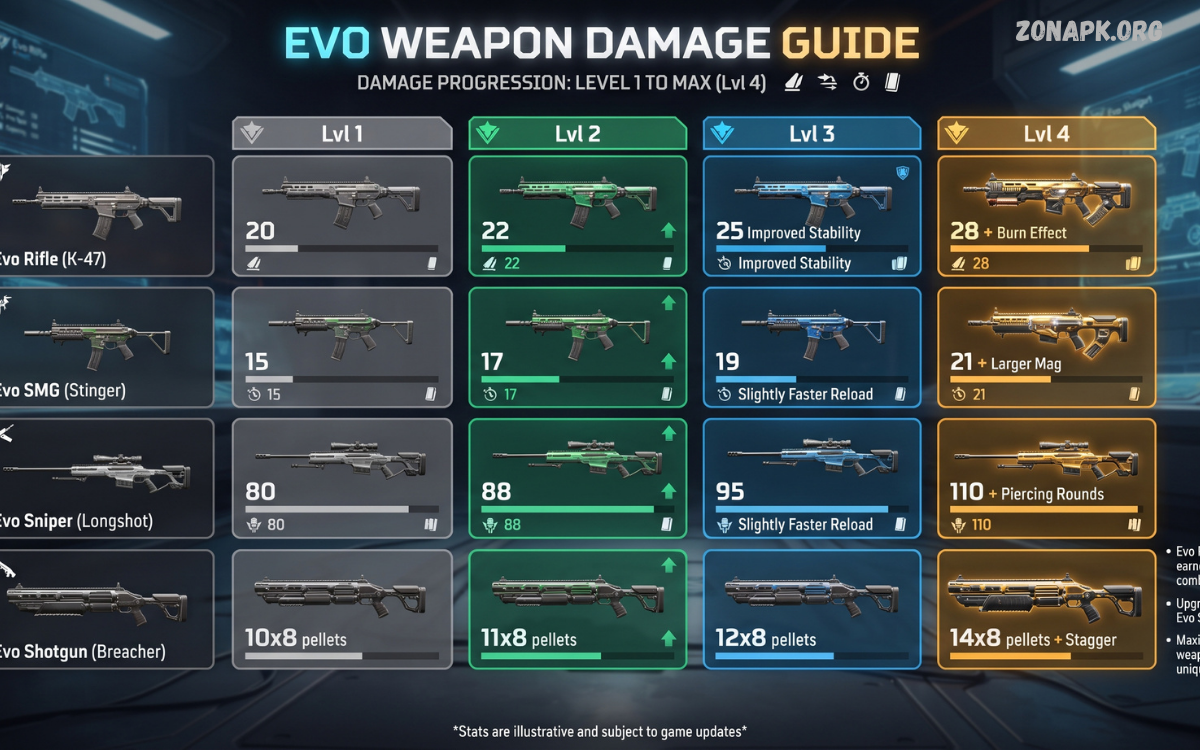
An evo weapon damage guide helps players understand how evolving weapons can improve combat performance through upgrades, enhanced attributes, special effects, and higher weapon levels. In competitive mobile games, weapon selection alone does not guarantee better results.
Evo weapons are designed around progression, allowing players to unlock additional features as the weapon reaches higher levels. Depending on the game, upgrades can affect damage, accuracy, rate of fire, armor penetration, reload performance, movement effects, or other combat attributes.
What Is an Evo Weapon?
An evo weapon is a progression-based weapon that becomes stronger or gains additional abilities through different upgrade levels. Unlike standard weapons with mostly fixed statistics, evo weapons generally provide a long-term progression system that rewards players for collecting required resources and completing specific objectives.
The exact upgrade system varies between games, but the central concept remains similar. A weapon begins with a base configuration and gradually unlocks enhanced statistics, visual effects, special abilities, or other gameplay benefits as its level increases. Players should understand each level rather than assuming every upgrade provides the same type of damage improvement.
Understanding Evo Weapon Damage
Weapon damage represents the amount of health an opponent loses when successfully hit. However, displayed damage should not always be interpreted as the final damage received by an enemy because factors such as hit location, armor, distance, weapon characteristics, and game-specific mechanics can influence the result.
An effective evo weapon damage guide therefore considers more than the basic damage number. Players should examine damage consistency, headshot potential, body-shot performance, effective range, rate of fire, recoil, magazine capacity, and reload speed before deciding whether a particular upgrade meaningfully improves overall combat effectiveness.
Evo Weapon Levels Explained
Most evo weapon systems use multiple levels, with each level providing specific improvements or unlocks. Early levels may introduce basic enhancements, while higher levels can provide more noticeable changes to statistics, visual effects, special abilities, or combat utility.
Players should avoid upgrading randomly when resources are limited. Checking every available level first can help determine which upgrades directly improve combat performance and which upgrades primarily provide cosmetic or secondary benefits. This approach creates a more efficient progression strategy.
Base Damage vs Upgraded Damage
Base damage refers to the weapon’s performance before relevant upgrades are applied. Upgraded damage describes the improved performance available after activating specific weapon enhancements. Comparing these values helps players understand the practical effect of progression.
A higher displayed damage value does not automatically make one weapon superior in every situation. A weapon with slightly lower damage but faster firing speed, better accuracy, or improved control may produce stronger overall results during actual matches.
How Damage Is Calculated
Damage calculation depends on the mechanics implemented by the individual game. A simplified model may consider base weapon damage multiplied or modified by factors such as hit location, armor, range, and special effects.
For example, a weapon can have strong base damage but lose effectiveness at longer distances. Another weapon may have moderate damage but maintain greater consistency because of superior accuracy or firing speed. Understanding these interactions is more useful than focusing exclusively on the largest damage number shown in a weapon menu.
Headshot Damage
Headshots generally represent one of the most important damage mechanics in competitive shooters. Many weapons provide significantly higher damage when bullets connect with the opponent’s head, making accuracy a major component of weapon effectiveness.
Players using evo weapons should therefore consider upgrades that support accuracy, recoil control, or other characteristics that make precise shots easier. High theoretical damage has limited value if players cannot consistently land accurate hits during real combat situations.
Body Damage
Body shots are usually easier to land than headshots, making body damage an important factor during fast-paced engagements. A weapon with reliable body-shot performance can remain effective when opponents are moving quickly or when precise headshots are difficult.
When comparing evo weapons, players should evaluate both headshot and body-shot potential. A balanced weapon can sometimes provide more consistent results than a weapon designed around extremely high damage under ideal conditions.
Damage and Rate of Fire
Rate of fire determines how quickly a weapon can deliver multiple shots. This statistic can significantly influence total damage output during an engagement, particularly when individual shots have moderate damage values.
A weapon with lower damage per bullet can potentially deliver competitive sustained damage when its firing speed is considerably higher. Players should therefore evaluate damage alongside rate of fire instead of treating damage as an isolated statistic.
Damage and Accuracy
Accuracy plays a major role in converting theoretical damage into practical damage. If a weapon has excellent damage statistics but produces substantial spread, players may struggle to land enough shots to achieve the expected performance.
Evo upgrades that improve accuracy can therefore have substantial practical value. Better accuracy allows more bullets to connect with the intended target, improving consistency without necessarily requiring a direct increase in the weapon’s displayed damage.
Damage and Range
Weapon damage can change according to distance in games that use damage falloff mechanics. Close-range encounters may produce maximum damage, while longer distances can reduce bullet effectiveness.
Players should understand the intended range of each evo weapon before selecting an upgrade or engagement strategy. Using a close-range weapon against distant targets may produce disappointing results even when the weapon has excellent base statistics.
Armor and Damage Reduction
Armor can reduce incoming damage depending on the game’s mechanics. Consequently, weapon damage statistics should be evaluated alongside the target’s defensive equipment and any available penetration characteristics.
If an evo weapon provides an armor-related benefit, players should understand when that benefit becomes useful. Defensive interactions can substantially change the outcome of an engagement, especially when opponents have strong protective equipment.
Evo Weapon Upgrade Strategy
A smart upgrade strategy begins by identifying the attributes that directly affect the player’s preferred combat style. Aggressive players may prioritize damage, firing speed, or close-range effectiveness, while players who prefer controlled engagements may value accuracy, range, recoil management, or stability.
Players should also consider resource efficiency. If an upgrade requires significant resources but provides only a minor practical improvement, saving resources for a more impactful level may be the better decision.
Best Way to Compare Evo Weapons
Comparing evo weapons requires evaluating multiple statistics simultaneously. Damage should remain an important consideration, but accuracy, rate of fire, effective range, magazine capacity, reload speed, recoil, and special abilities can also influence performance.
A useful comparison method is to evaluate weapons under the same conditions. Test them at similar distances, against similar targets, and with comparable equipment. This creates a clearer understanding of practical performance instead of relying exclusively on menu statistics.
Close-Range Damage Performance
Close-range battles often favor weapons capable of delivering high burst damage quickly. In these situations, damage per shot, rate of fire, magazine capacity, and reload speed can determine whether a player wins an engagement.
Evo upgrades that improve close-range performance can be particularly useful for aggressive gameplay. Players should combine suitable weapons with movement, positioning, and accurate aiming rather than relying exclusively on increased weapon statistics.
Mid-Range Damage Performance
Mid-range combat requires a balance between damage, accuracy, recoil control, and firing speed. Weapons that maintain consistent accuracy at moderate distances can provide reliable performance across different situations.
When selecting an evo weapon for mid-range battles, players should examine how quickly damage decreases with distance. Consistent damage combined with manageable recoil can often provide greater practical value than extreme close-range damage.
Long-Range Damage Performance
Long-range engagements place greater importance on precision and damage consistency. Even a powerful weapon can become ineffective when bullet spread, recoil, or damage falloff prevents reliable hits.
Players should prioritize accuracy and controlled firing when using evo weapons at longer distances. Understanding effective range helps prevent unnecessary engagements where the selected weapon has a significant disadvantage.
Recoil Control and Damage
Recoil does not necessarily change the weapon’s listed damage, but it strongly influences how much damage a player can actually deliver. Excessive recoil can cause bullets to miss the intended target, reducing practical damage output.
Players should practice controlled firing patterns and learn the weapon’s recoil behavior. Combining recoil management with appropriate upgrades can make an evo weapon significantly easier to use during extended engagements.
Reload Speed and Sustained Damage
Reload speed becomes important during prolonged fights. A weapon with excellent damage can lose an engagement if the magazine is depleted at a critical moment and the reload animation takes too long.
Evo weapon upgrades that improve reload performance can increase sustained combat effectiveness. Players should consider magazine size and reload speed together when evaluating total damage potential.
Common Evo Weapon Mistakes
One common mistake is focusing exclusively on the highest damage statistic. Players may overlook accuracy, range, firing speed, recoil, and other factors that determine whether the weapon can consistently deliver that theoretical damage.
Another mistake involves upgrading without understanding the progression system. Players can waste valuable resources on less useful improvements when they could have prioritized upgrades that directly support their preferred playstyle.
Read Also: Evo Weapon Attributes: Complete Guide to Stats, Upgrades & Gameplay
Tips for Maximizing Evo Weapon Damage
Use the weapon within its effective range and focus on accurate shots rather than uncontrolled firing. Learn the recoil pattern, understand the weapon’s damage behavior, and practice aiming techniques that improve hit consistency.
Choose upgrades based on measurable combat benefits and your preferred playstyle. Test different configurations whenever possible, compare performance under similar conditions, and prioritize improvements that provide consistent value throughout a match.
Evo Weapon Damage Testing
Testing provides a practical way to understand whether an upgrade actually improves performance. Players can compare damage values, firing speed, accuracy, reload time, and other characteristics before and after upgrading the weapon.
Controlled testing is especially useful when game updates change weapon statistics. Patch adjustments can alter damage, recoil, range, or special effects, meaning older information may no longer accurately represent current weapon performance.
Impact of Game Updates
Developers frequently balance weapons through updates. Damage values, upgrade effects, firing speed, recoil, and other characteristics can change as developers adjust the game’s competitive environment.
For this reason, players should verify current weapon statistics whenever a major update is released. An evo weapon that previously dominated a particular combat situation may become less effective after a balance adjustment.
Choosing the Right Evo Weapon
The best evo weapon depends on the player’s preferred combat style and the specific requirements of the game. There is rarely one weapon that performs perfectly in every situation, making versatility an important factor when selecting equipment.
Players should identify whether they prefer aggressive close-range fights, controlled mid-range engagements, or precision-based long-range combat. Matching the weapon’s strengths with the player’s abilities can produce better results than simply selecting the weapon with the highest listed damage.
Frequently Asked Questions
What is an evo weapon damage guide?
An evo weapon damage guide explains weapon damage, upgrade levels, damage mechanics, range, accuracy, recoil, and other factors that influence combat performance.
Does upgrading an evo weapon always increase damage?
Not necessarily. Some upgrades may improve accuracy, firing speed, reload performance, special abilities, or other characteristics instead of directly increasing damage.
Is higher damage always better?
No. Practical performance also depends on accuracy, rate of fire, range, recoil, magazine capacity, reload speed, and the player’s ability to use the weapon effectively.
How can I improve evo weapon damage?
Focus on accurate shots, learn the weapon’s effective range, control recoil, select useful upgrades, and practice consistently.
Does range affect weapon damage?
In games with damage falloff, damage can decrease as the distance between the attacker and target increases. The exact mechanics depend on the game.
Why are headshots important?
Headshots commonly deal higher damage than body shots, making precise aiming an important skill for maximizing weapon effectiveness.
Should I prioritize damage upgrades?
Prioritize upgrades according to your playstyle and the weapon’s strengths. Direct damage improvements can be valuable, but accuracy, firing speed, or other upgrades may provide greater practical benefits.
How does armor affect evo weapon damage?
Armor can reduce incoming damage according to the game’s defensive mechanics. Some weapons or upgrades may provide characteristics that improve performance against armored targets.
Can weapon updates change damage?
Yes. Developers can modify weapon statistics through balance updates, potentially changing damage, recoil, range, firing speed, or upgrade effects.
What is the most important factor in weapon performance?
There is no single factor that determines performance. Damage, accuracy, firing speed, range, recoil, reload speed, and player skill all contribute to effective weapon usage.
Conclusion
A strong evo weapon damage guide should look beyond basic damage statistics and examine the complete weapon system. Upgrade levels, accuracy, rate of fire, range, recoil, reload speed, armor interaction, and special abilities can all influence the amount of damage a player delivers during real combat.
The most effective approach is to understand the weapon’s strengths, select upgrades strategically, practice accurate shooting, and adapt the weapon to the situation. By combining reliable game knowledge with consistent practice, players can make better upgrade decisions and maximize the practical performance of their evo weapons.

1 Comment
Pingback: Evo Weapon Effects: Complete Guide to Visual Effects, Features & Upgrades in 2026 - Zonapk